
 Written by
 Faceless YouTube Automation: How to Build a YouTube Channel Without Showing Your Face
Faceless YouTube automation has become one of the most talked-about opportunities in the creator economy. The idea is simple: build a YouTube channel without appearing on camera and create videos using narration, animation, stock footage, screen recordings, graphics, editing software, and AI-assisted tools.
The rise of AI content creation, YouTube automation, passive-income businesses, and viral video formats has attracted thousands of aspiring creators. However, the biggest misconception is that automation means creating videos automatically and making money without doing any work. The reality is very different. Successful faceless YouTube channels still require research, creativity, storytelling, editing, quality control, audience analysis, and consistent publishing.
The biggest advantage of a faceless YouTube channel is that the creator does not have to become the public face of the business. Someone who is uncomfortable appearing on camera can still build a large audience around subjects such as technology, business, education, history, science, entertainment, finance, documentaries, and interesting facts.
What Is Faceless YouTube Automation?
Faceless YouTube automation is a content-production model in which the creator builds and manages a channel without appearing on camera. Instead, the videos can use voiceovers, animations, screen recordings, licensed footage, original graphics, charts, captions, and other visual elements.
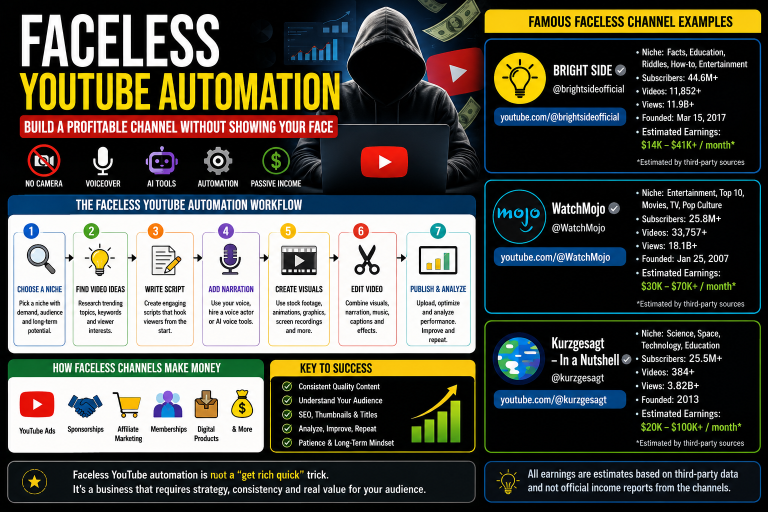
The word automation refers primarily to the workflow. A creator can organize the process into separate stages such as research, scriptwriting, narration, video production, editing, thumbnail design, publishing, and analytics. Some creators perform these tasks themselves, while larger channels may use teams, freelancers, software, or AI tools.
This makes YouTube automation closer to building a small media company than simply running a personal YouTube account.
Why Is Faceless YouTube Becoming So Popular?
The popularity of faceless channels has increased as video-editing software, AI tools, voice technology, animation platforms, and affordable freelance services have become easier to access.
Creators no longer need an expensive camera setup or a studio to start producing videos. A computer, microphone or suitable narration solution, editing software, research tools, and a strong content idea can be enough to begin.
That accessibility has also created intense competition. Thousands of channels now target popular keywords and viral topics, which means simply producing more videos does not guarantee success.
The strongest faceless YouTube channel ideas usually combine a clearly defined audience with a repeatable content format.
Choosing a Niche
The first major decision is choosing a niche. A niche determines the audience a channel will target and the subjects it can cover.
Popular faceless niches include technology, artificial intelligence, business, history, science, education, entertainment, documentaries, personal finance, productivity, and interesting facts.
However, creators should not choose a niche simply because someone claims it is a “high CPM” or “easy money” category. A successful channel needs enough topics to support months or years of publishing.
A good niche should therefore have three characteristics: an identifiable audience, a steady supply of interesting topics, and room for original content.

Finding Viral Video Ideas
After choosing a niche, creators need a steady supply of video ideas. This is where viral YouTube videos and trending topics can provide inspiration.
Creators can study videos that are attracting views and identify patterns in titles, subjects, thumbnails, storytelling, and audience questions. The objective should not be to copy another creator. Instead, creators can identify an interesting topic and develop a completely different explanation, story, argument, or presentation.
For example, if several channels are discussing a major technology development, a new channel could focus on explaining how the technology works, its potential impact, the companies involved, or the history behind it.
Writing the Script
A strong script is one of the most important parts of faceless YouTube automation because there is no on-camera personality carrying the video.
The opening should quickly establish the subject and give viewers a reason to continue watching. The middle of the video should deliver useful, entertaining, or surprising information while maintaining a clear narrative.
AI tools can assist with brainstorming, research organization, outlines, and early drafts. However, creators should review AI-generated information carefully. Human editing and fact-checking remain essential, particularly for news, finance, science, health, and other subjects where inaccurate information can damage credibility.
Narration and Voiceovers
Once the script is ready, the creator needs narration.
The narration can come from the creator, a professional voice actor, or an appropriate AI voice. The most important factor is that the voice fits the content and sounds natural.
A documentary channel may require a serious storytelling style, while a technology explainer might use a faster and more energetic presentation.
Good narration can turn basic visuals into an engaging video, while weak narration can make even excellent visuals difficult to watch.
Creating the Visuals
Visual storytelling becomes particularly important when there is no host on screen.
Depending on the niche, creators can use licensed stock footage, original animations, charts, screen recordings, illustrations, screenshots, diagrams, and other properly licensed material.
Every visual should serve a purpose. It should help explain the narration, maintain attention, establish context, or make the information easier to understand.
Copyright is also critical. Creators should not simply download videos, music, photographs, or clips from the internet and assume they can legally reuse them. Building a sustainable YouTube business requires respecting copyright and obtaining the necessary rights or permissions.
Editing and Production
Editing combines the script, narration, visuals, music, captions, sound effects, transitions, and graphics into a finished video.
Good editing does not necessarily mean adding an effect every few seconds. Instead, the goal is to create strong pacing and make the information easy to follow.
This is where a repeatable content automation workflow becomes useful. A creator can create templates for intros, captions, graphics, transitions, thumbnails, and other recurring elements, reducing production time without sacrificing quality.
Famous Faceless YouTube Channel Examples
Some of the world’s largest YouTube channels demonstrate that a creator does not necessarily need to appear on camera to build an enormous audience.
BRIGHT SIDE
BRIGHT SIDE is one of the clearest examples of high-volume faceless YouTube content. The channel focuses on trivia, interesting facts, riddles, history, knowledge, how-to content, and entertainment. It launched on March 15, 2017 and, as of late August 2026, has approximately 44.6 million subscribers, 11.9 billion views, and 11,852 videos, according to Social Blade.
Third-party services provide different estimates of its advertising revenue. For example, vidIQ currently estimates roughly $14,000 in monthly earnings, while other analytics services produce substantially different ranges. These figures are estimates rather than confirmed income from BRIGHT SIDE itself.
The channel’s growth also demonstrates the importance of scale. After roughly nine years, BRIGHT SIDE has built an enormous library of videos rather than relying on a small number of uploads. This is an example of a high-volume YouTube automation model, where a repeatable production system can support thousands of pieces of content.
WatchMojo
WatchMojo provides another major example of a faceless content business. Its niche focuses heavily on entertainment, pop culture, movies, television, music, rankings, and list-based videos.
The YouTube channel was created on January 25, 2007. By late August 2026, Social Blade listed approximately 25.8 million subscribers, 18.1 billion views, and 33,757 videos.
The important lesson is how long the company took to build its audience. WatchMojo did not become a giant YouTube channel overnight. It spent years developing its content format and audience. Its huge video library shows how a repeatable format can become a large-scale media business when combined with consistent publishing.
Third-party YouTube analytics services estimate advertising revenue based on views and advertising assumptions, but these should not be interpreted as WatchMojo’s actual reported earnings. Revenue can also come from sources beyond YouTube advertising, including sponsorships, licensing, partnerships, and other business activities.
Kurzgesagt – In a Nutshell
Kurzgesagt – In a Nutshell demonstrates a completely different approach to faceless YouTube content. The channel focuses on science, space, biology, technology, history, and complex ideas explained through highly produced animation.
Kurzgesagt launched its YouTube channel in 2013. By late August 2026, Social Blade listed approximately 25.5 million subscribers, 3.82 billion views, and 384 videos.
This example is particularly interesting because Kurzgesagt has produced far fewer videos than BRIGHT SIDE or WatchMojo while still generating billions of views. Its official channel describes the team as illustrators, animators, and researchers who create videos explaining science and the world through storytelling.
Third-party analytics also estimate advertising revenue based on recent views. Social Blade’s daily estimates in August 2026 ranged from hundreds to several thousand dollars on individual days, demonstrating how dramatically estimated earnings can fluctuate with view volume. These figures are not official income disclosures.
Kurzgesagt proves that faceless YouTube success does not require thousands of videos. A smaller library can generate enormous results when each video has a compelling concept, strong storytelling, original visuals, and high production quality.
What These Successful Channels Have in Common
The three channels demonstrate three different approaches to YouTube automation.
BRIGHT SIDE shows the power of high-volume content. WatchMojo demonstrates the potential of a recognizable and repeatable entertainment format. Kurzgesagt shows how premium animation, storytelling, research, and originality can produce enormous audiences with a much smaller number of videos.
There is therefore no single formula for creating a viral YouTube channel.
A creator does not need to publish thousands of videos to succeed. At the same time, publishing only a handful of videos does not guarantee success. The right strategy depends on the niche, audience, production quality, publishing frequency, and ability to create videos that people actually want to watch.
How Long Does It Take to Build a Big Faceless Channel?
The examples above show that building a major YouTube channel can take years.
BRIGHT SIDE has been operating since 2017, WatchMojo’s YouTube channel dates back to 2007, and Kurzgesagt began in 2013. Their current audience sizes are the result of years of publishing, experimentation, brand development, and audience growth.
That is important for anyone searching for how to make money on YouTube. A new creator should not assume that a channel will become profitable within weeks simply because AI tools can speed up production.
The technology can make content creation faster, but it cannot guarantee viewers.
How Faceless YouTube Channels Make Money
Once a channel becomes eligible for YouTube’s monetization programs, advertising can become one source of revenue. Successful creators may also build additional revenue streams through sponsorships, affiliate marketing, memberships, digital products, licensing, and other businesses.
That means the real opportunity may be larger than YouTube advertising alone. A successful channel can become a media brand with multiple ways to generate revenue.
However, earnings vary enormously between channels. View count, audience location, niche, video length, advertising demand, seasonality, and other factors can influence advertising revenue.
Therefore, online claims promising a specific amount of money for a certain number of views should be treated cautiously.
The Role of AI in YouTube Automation
AI has made faceless YouTube automation more accessible by helping creators brainstorm topics, organize information, generate draft scripts, assist with editing, create graphics, and streamline repetitive tasks.
But AI should be viewed as a production tool rather than a replacement for creativity.
Uploading large quantities of generic AI-generated videos is unlikely to create a durable media brand. Successful channels still need original ideas, strong storytelling, accurate information, compelling thumbnails, and a clear understanding of their audience.
The biggest opportunity is therefore not simply AI-generated YouTube videos. It is using AI to make a good content-production system more efficient.
The Biggest Mistake Beginners Make
The biggest mistake is treating faceless YouTube automation as a get-rich-quick strategy.
There are countless videos, courses, and social-media posts claiming that creators can generate passive income with almost no effort. The real examples tell a different story. The largest faceless channels have spent years building audiences and developing production systems.
Successful automation means removing unnecessary repetitive work while keeping human oversight over the parts that matter: ideas, storytelling, accuracy, originality, quality, and audience understanding.
Final Thoughts
Faceless YouTube automation can be a powerful way to build a digital media business without appearing on camera. The examples of BRIGHT SIDE, WatchMojo, and Kurzgesagt show that faceless content can scale from a small creator project into a major YouTube brand.
But these channels also provide an important reality check. They did not become successful simply because someone automated video production. They built recognizable formats, developed audiences, published consistently, and created content that viewers wanted to watch.
For new creators, the biggest opportunity is to combine AI content creation, smart research, original storytelling, efficient production, strong thumbnails, viral topics, and YouTube analytics into a repeatable system.
The goal should not be to produce the most videos possible. The goal should be to build a channel that viewers want to come back to.