

 Written by
 How Ben Broca Built a One-Person AI Company That Reached Millions in Revenue
Artificial intelligence is creating a new kind of startup story: companies that can serve thousands of customers without building a traditional workforce. One of the most striking examples is Ben Broca, the French entrepreneur behind Polsia, an AI platform designed to build and operate businesses.
Polsia launched in December 2025. By 2026, Broca reported rapid growth, and reporting from The Wall Street Journal said the company had reached around 10,000 paying customers and was on track for approximately $10 million in 2026 revenue — while Broca remained the company’s only employee.
The story is not simply that Ben Broca “used AI to get rich.” What makes Polsia interesting is the way he built the company around AI from the start.

From Entrepreneurship to Polsia
Ben Broca wasn’t a first-time entrepreneur who suddenly discovered AI. His background includes engineering studies at Columbia University and experience at CloudKitchens, the company associated with entrepreneur Travis Kalanick. He later moved from France to the United States and eventually focused his attention on building AI-native businesses.
In 2025, Ben Broca began experimenting with the idea that AI could do more than assist a founder. Instead, AI agents could potentially handle substantial portions of a company’s actual operations. That became the foundation for Polsia.
The platform was launched in December 2025 and was designed around a simple proposition: give entrepreneurs AI systems that can help create and operate businesses rather than merely answer questions.
What Happened After He Started Polsia?
Broca’s approach was different from the typical SaaS startup. Instead of immediately hiring programmers, marketers, customer-service representatives and operations staff, he built systems that could perform many of those functions through AI.
Polsia’s platform can provision infrastructure and connect services needed to operate a business. Reported components of its technology stack include Node.js, Redis, BullMQ, Render, Neon/PostgreSQL and Stripe, while its AI architecture has been described as using models such as Claude Opus, alongside agent frameworks and the Model Context Protocol (MCP).
The exact technology stack has evolved, so it is better to view these as reported components rather than a permanent list. The broader idea is more important: AI agents can be connected to real business systems instead of being used only as chatbots.

How the Money Worked
Polsia’s business model gave Ben Broca a way to generate recurring revenue from entrepreneurs using the platform. Published accounts describe pricing of roughly $49–$50 per month plus a share of revenue generated by businesses created through the platform.
That model gives Polsia two potential sources of revenue: subscription payments and participation in the businesses operating through its platform.
There is an important distinction, however. Reported revenue figures for Polsia are company revenue or run-rate figures, not Broca’s personal income. The same applies to fundraising. Polsia later raised $30 million at a reported $250 million valuation. That was capital invested into the company, not $30 million paid directly to Broca.
How Much Did He Personally Invest?
This is where it is important not to exaggerate the story. There is public evidence of Broca’s business spending and fundraising strategy, but I would not claim that he personally invested a specific large amount of money unless he has directly disclosed that figure.
What is documented is that Polsia’s own fundraising material proposed putting 70% of a $10 million raise toward infrastructure and AI compute, with the remaining 30% allocated to growth and distribution. That gives some insight into where an AI-native company’s money goes.
Compute is not free. Running large numbers of AI agents, processing requests and maintaining infrastructure creates real costs. Broca has also discussed the importance of controlling those costs and improving margins as the company scales.
The Strategy That Made Polsia Stand Out
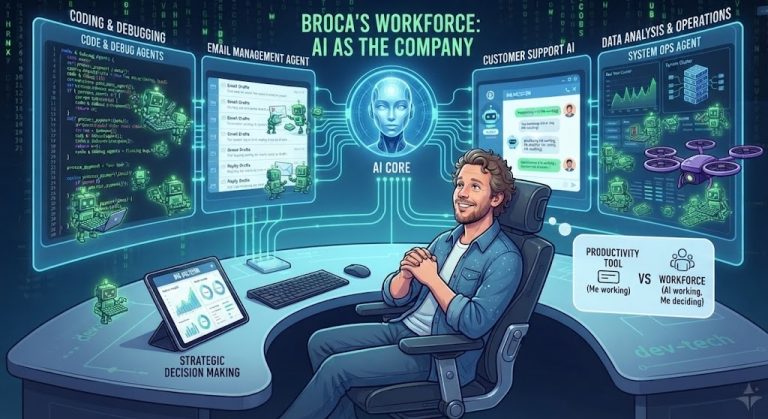
Broca’s biggest insight was arguably using AI as the company’s workforce rather than simply as a productivity tool. AI systems could work on coding, debugging, emails, customer support and other repetitive operations. Broca could then concentrate on higher-level decisions.
In one of his own updates, Broca described the company as reaching a $9 million run rate, with AI agents handling much of the workload while difficult edge cases still came back to him. That last point matters because the company wasn’t literally autonomous in every situation. Broca remained the human responsible for decisions and exceptions.
How Polsia Got Attention
The marketing strategy was almost as interesting as the technology. Broca openly shared Polsia’s growth on social platforms, including revenue milestones and the unusual fact that the company had one founder and zero employees. That created a story people wanted to follow.
His most unusual marketing move came during Polsia’s fundraising process. Broca gave an AI agent access to his inbox and allowed it to handle much of the investor outreach. He also created a live dashboard showing company metrics. The stunt itself became a marketing event, attracting attention from investors and technology audiences.
Broca later told PitchBook that the AI-led fundraising stunt generated real product traction as the company’s revenue and live metrics were rising. He still participated in negotiating terms and meeting promising investors.
So the virality wasn’t simply luck. The product’s unusual business model became the marketing.
The Growth Was Extremely Fast
Polsia’s reported numbers changed rapidly during its first months. An earlier account documented Polsia crossing $1 million in annual recurring revenue after starting from roughly $100,000, while later reports described the business reaching several million dollars in annualized revenue.
Broca himself subsequently reported milestones including a $2.5 million run rate and later a $9 million run rate. These are founder-reported figures and should be described as such rather than treated as independently audited financial statements.
By May 2026, the company had attracted a $30 million funding round at a reported $250 million valuation.
What Entrepreneurs Can Learn
The most important lesson from Broca’s story isn’t that AI guarantees enormous profits. It is that the economics of starting a company are changing. A founder can now connect AI agents to software, databases, payment systems, email and other business infrastructure. That makes it possible to automate work that previously required multiple employees.
But Polsia also shows the limits of the idea. AI still needs supervision, infrastructure costs money, and automated systems can make mistakes. Broca himself has acknowledged that difficult cases can still reach the human founder. The opportunity, therefore, isn’t simply to “use AI.” It is to find a valuable problem, build a product around it, automate as much repetitive work as possible and keep improving the system as customers arrive.
Ben Broca’s Polsia story is one of the clearest examples yet of that model: one founder, AI agents doing much of the operational work, thousands of customers and a business that attracted a $250 million valuation.
That makes Polsia less of a story about getting rich from AI overnight — and more a case study in what happens when an entrepreneur decides to build the entire company around AI from day one.