
 Written by
 Outbid.lol: The $5 Idea That Turned Website Rankings Into a Viral Bidding War
Outbid.lol is a surprisingly simple viral pay-to-rank website where the amount of money you are willing to pay determines your position on a public leaderboard. Instead of competing through SEO, backlinks, keywords, or Google’s ranking algorithm, users can submit a link, place a bid, and compete for a higher position.
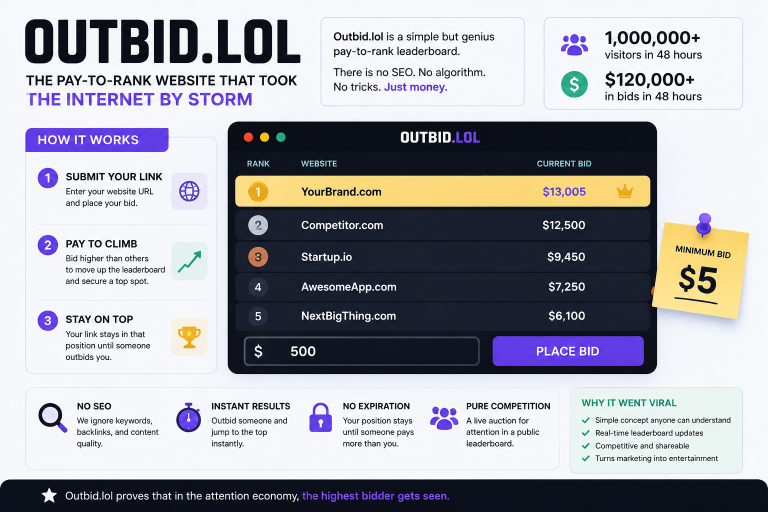
The project launched on August 19, 2026, and quickly attracted more than one million visitors and $120,000 in bids within its first 48 hours, according to a company announcement.
The concept is simple enough to explain in seconds: submit a link, place a bid, and your payment determines where you appear on the leaderboard.
There is no complicated SEO formula to understand. There is no content score to improve. And there is no mysterious algorithm deciding who gets the top position.
Money determines the ranking.
How Outbid.lol Works
The website is built around an unusually simple mechanism.
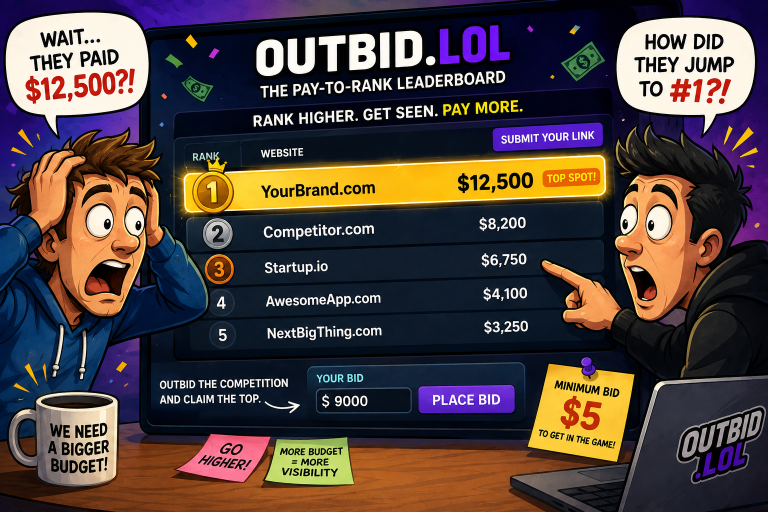
A company or individual submits a website link and enters the leaderboard by paying a minimum amount. The starting price is $5. From there, participants can spend more to move higher on the public ranking.
That creates an immediate competitive loop.
Imagine one company pays $100 for a position. Another company wants to appear above it, so it pays more. A third participant sees the new price and decides to challenge the top position.
Suddenly, a basic website directory becomes a live auction.
And that is where the idea becomes interesting.
The ranking itself becomes content.
Every time somebody makes a large bid, the leaderboard changes. People can screenshot the new rankings, share them on social media, and discuss who is spending money to reach the top.
The competition effectively markets the platform for free.
It’s Not Google SEO
One of the biggest misconceptions about the concept is comparing it with Google search rankings.
Outbid.lol does not work like Google.
Google evaluates billions of web pages using a complex ranking system involving relevance, content, links, technical signals, user experience, and many other factors.
Outbid.lol has a much simpler rule: the amount paid determines the position.
That difference is important.
A company cannot improve its position by writing a better article, earning more backlinks, improving its website speed, or optimizing a keyword. Instead, the company has to compete financially for visibility.
In other words, it is closer to a public advertising auction than a traditional search engine.
Why Did It Go Viral?
The biggest reason may be the psychology behind the leaderboard.
People naturally pay attention to competition.
A normal directory showing 700 companies is not particularly exciting. But a public leaderboard showing companies competing for the #1 position is different.
The price becomes part of the story.
According to the launch announcement, 705 companies had taken positions by the second day, while the top position had reached $13,005. The site also generated thousands of click-throughs for leading listings.
That creates a powerful feedback loop:
More visitors → more attention → more bidders → higher bids → more social-media discussion → more visitors.
The platform essentially turned its own popularity into a marketing engine.
The Million-Visitor Effect
The numbers are what made the experiment especially remarkable.
Outbid.lol reportedly attracted more than one million visitors in its first 48 hours. The sudden traffic surge was reportedly large enough to overwhelm its original analytics provider, forcing a change in its tracking infrastructure.
The project also reportedly received a $100,000 acquisition offer, which the founder declined.
That is an extraordinary outcome for a project centered around a single public page and a simple bidding mechanism.
It also demonstrates something important about internet businesses: simplicity can sometimes be an advantage.
The product did not require dozens of features to attract attention. Its entire concept could be explained in one sentence.
Why Companies Were Willing to Pay
The obvious question is: why would a company spend hundreds or thousands of dollars simply to appear higher on a leaderboard?
The answer is visibility.
The site became a gathering point for founders, developers, investors, and technology enthusiasts. A high-ranking listing could potentially generate direct traffic while also creating social-media exposure.
More importantly, the competition itself created a sense of urgency.
Once a company paid for a position, another company could challenge it. That transformed advertising from a passive purchase into an active competition.
Instead of simply buying an advertisement, companies were effectively competing for attention in public.
The Bigger Lesson for Startup Marketing
The Outbid.lol experiment offers an interesting lesson for founders and marketers.
The internet is filled with complicated marketing systems. Companies spend money on SEO, paid advertising, influencer campaigns, newsletters, sponsorships, and social-media promotion.
Outbid.lol took the opposite approach.
It reduced the entire concept to one visible rule:
Pay more and move higher.
That simplicity made the product easy to understand, easy to share, and surprisingly entertaining to watch.
However, the long-term question remains whether the model can maintain its momentum after the initial viral wave fades. The launch itself acknowledged that it remains unclear whether an open market for attention can maintain high prices once the novelty disappears.
The Future of Pay-to-Rank Websites
Outbid.lol has already inspired copycat projects, with multiple similar platforms reportedly appearing within days of its launch.
That may ultimately be the most interesting part of the experiment.
The project demonstrates how a three-hour-style side-project concept can become a viral internet phenomenon when the underlying mechanic creates competition, curiosity, and social sharing.
Outbid.lol may not replace Google, SEO, or traditional advertising. It doesn’t need to.
Its real innovation is turning online visibility into a public competition.
And in an internet economy where attention is becoming increasingly valuable, that may be the idea worth watching.